HACKER TUBES / Playlists
When data leaves one machine
A route through relational databases, distributed systems, consensus, event streams, and testing failure.
6 vídeos · 4 horas 55 min
Começar a assistirOrdem sugerida
Escolha um vídeo. Na página de reprodução, use os links anterior e próximo para continuar.
- 01
01 - Course Introduction & Relational Model (CMU Databases Systems / Fall 2019)
CMU Database Group · 6 recomendações no HNThe first lecture of Andy Pavlo's CMU 15-445 Intro to Database Systems (Fall 2019), covering course introduction and the relational model.
- 02
Distributed Systems 1.1: Introduction
Martin Kleppmann · 5 recomendações no HNThe first lecture in Martin Kleppmann's 8-lecture distributed systems series from the University of Cambridge undergraduate course. It introduces the subject, and accompanying lecture notes are available.
- 03

Raft lecture (Raft user study)
Diego Ongaro · 4 recomendações no HNJohn Ousterhout lectures on the Raft consensus algorithm, made for the Raft user study comparing how students learn Raft and Paxos. It covers leader election and log repair.
- 04
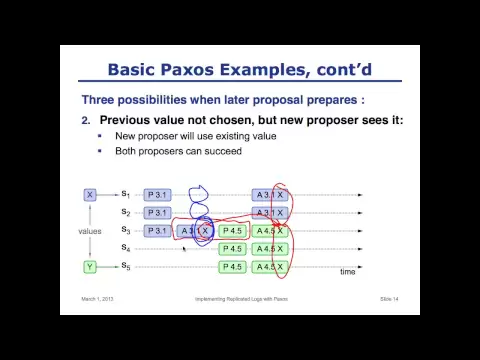
Paxos lecture (Raft user study)
Diego Ongaro · 6 recomendações no HNJohn Ousterhout's slides-and-voiceover lecture on Paxos, made for the Raft user study comparing how students learn Raft and Paxos. It is a full introduction to the Paxos consensus algorithm.
- 05

"Turning the database inside out with Apache Samza" by Martin Kleppmann
Strange Loop Conference · 9 recomendações no HNMartin Kleppmann argues that databases are global shared mutable state and proposes treating them as an ever-growing log of immutable facts. Derived data such as caches, indexes and views is then built by stream processors like Apache Samza. The talk draws on Kafka and LinkedIn's experience with commit logs.
- 06

"Testing Distributed Systems w/ Deterministic Simulation" by Will Wilson
Strange Loop Conference · 12 recomendações no HNWill Wilson of FoundationDB explains how the team tested their distributed database using deterministic simulation. By running the whole system in a simulator with injected faults and reproducible seeds, they could find rare concurrency and network bugs.